
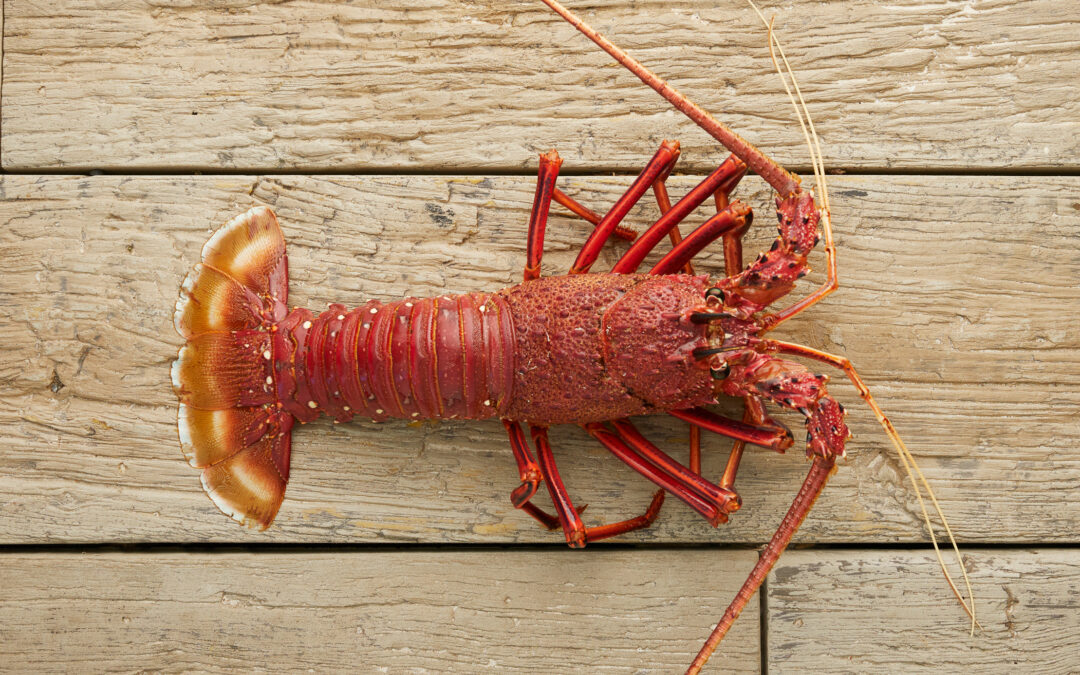
If you have flown in from somewhere with cold Atlantic winters, the first western rock lobster you see will look wrong. There are no big front claws. Just a heavy, armoured tail, long whip like antennae and a body built like something that has been surviving on a reef for a very long time.
That is not a lesser lobster. It is a different animal entirely, and once you know what you are looking at, most of the confusion about how it tastes and how it should be cooked sorts itself out.
Here is what actually sets our local lobster apart, why it is called about four different things depending on who you ask, and the one mistake that gives spiny lobster an undeserved reputation.
The Big One, No Claws
Lobsters split broadly into two families. Clawed lobsters, which is what most of the northern hemisphere eats, carry two large front claws holding a good share of the meat. Spiny lobsters, which is what we have here, have no large claws at all.
Instead they have long, thick antennae and a heavily armoured body covered in forward facing spines, which is where the name comes from. Our species is Panulirus cygnus, a member of the spiny lobster family Palinuridae, and it is one of the reasons a plate here looks different to one in Boston.
What That Means On The Plate
Almost all the meat is in the tail. That is not a shortcoming, it is simply where it lives, and it changes a few things.
- Portioning is simpler, since the tail is the meal rather than one component of it.
- There is no cracking, picking or specialised tooling required. A tail splits cleanly.
- The meat is firmer and holds together better on a grill, which is why so much of it is served split and grilled here.
- Less of the meal is spent on the labour of extraction, which some people miss and others are quietly relieved about.
Why It Has So Many Names
Order one in Western Australia and you may see it called any of the following, all describing the same animal.
- Western rock lobster. The proper common name and what the fishery uses.
- Crayfish, or cray. What most Western Australians actually say. Confusing for visitors, since crayfish means a freshwater animal in much of the world, a distinction the Western Australian Museum sets out plainly.
- Australian spiny lobster. Used in export markets.
- Rock lobster. The general category, shared with the southern rock lobster found further around the coast.
If someone offers you a cray in Cervantes, they are not talking about a yabby. They mean this.
That marking is not folklore. It appears in the official recreational fishing guide as the identifying feature for the species.
Where It Lives, And Why That Matters
Western rock lobsters are endemic to the west coast of Western Australia, running from up near North West Cape all the way down to Cape Leeuwin. Young ones favour shallow inshore reef, generally in water less than forty metres deep, which is why this stretch of coast supports them so well.
They are also nocturnal, and this has been studied properly rather than assumed. Research tracking their movements confirms they shelter in reef holes, cracks and dens through the day, then leave the reef at night to forage across nearby seagrass meadows and algae beds. If you have ever wondered why pots get pulled early in the morning, that is why.
The Temperature Point Nobody Makes
There is a widely held view among seafood eaters that colder water makes for better shellfish. Whether or not that holds universally, it is worth knowing that this stretch of coast is classified as a temperate marine environment rather than a tropical one.
That matters because spiny lobster gets lumped together as one thing, and it is not. The group is distributed across tropical, subtropical and temperate waters worldwide, with real differences in eating quality between them. Someone comparing a Western Australian lobster to a memory of a warm tropical one is not comparing like with like.
So Does It Taste Better Or Worse?
Honest answer, people genuinely disagree, and preference tracks what you grew up eating more than anything else.
Those raised on clawed lobster often describe it as sweeter and more delicate. Those raised on spiny lobster describe theirs as sweeter and crisper, with a firmer texture they prefer. Both groups are certain, and neither is wrong about their own plate.
| Western rock lobster | Clawed lobster | |
|---|---|---|
| Claws | None of any size | Two large claws |
| Where the meat is | Almost entirely the tail | Tail and claws |
| Texture | Firmer, denser | Softer, more delicate |
| Best suited to | Grilling and barbecuing, split in the shell | Boiling and steaming |
| Forgiveness when overcooked | Low, it firms up quickly | Higher |
| Eating effort | Minimal, the tail does the work | Cracking and picking involved |
The Mistake That Ruins It
Here is the thing worth knowing above everything else, and it explains most of the bad reviews spiny lobster gets anywhere in the world.
It is less forgiving of overcooking than clawed lobster. The reason is straightforward food science. Heat causes the muscle proteins to contract and squeeze out moisture, and work on how cooking method affects seafood shows how quickly that changes texture. The firmer meat that makes this species excellent on a grill also means it tightens fast once it goes past done, and the difference between beautiful and rubbery is a surprisingly small number of minutes.
People who say spiny lobster is tough and tastes of nothing have usually eaten it overcooked. Cooked properly, that firmness becomes the best thing about it, holding together under heat in a way softer meat simply cannot.
That is also why a lot of visitors have their best lobster experience somewhere that cooks it every single day, rather than the one time a year they try it at home.
A Fishery Worth Knowing About
This is not a niche local catch. Western rock lobster underpins Australia’s most valuable single species fishery, worth several hundred million dollars a year and accounting for roughly a fifth of the value of the national wild catch industry.
It is also managed carefully, and the record here is genuinely notable rather than a marketing line. The fishery was the first in the world certified to the Marine Stewardship Council standard, and it has since gone on to achieve a fifth certification. Seasons, minimum sizes and catch limits are set from stock assessment rather than tradition, with breeding stock monitored to decide what can sustainably be taken.
For anyone who thinks about where their seafood comes from, that is a large part of what makes eating one here defensible as well as enjoyable. If you would like to see how it works rather than read about it, our lobster production process covers what happens between the pot and the plate.
What The Research Actually Shows
- The species and family are settled. Panulirus cygnus is a spiny lobster, and spiny lobsters genuinely lack the large claws of the clawed species.
- The white dot identification is official, published in the state recreational fishing guide rather than passed around by word of mouth.
- The nocturnal reef and seagrass pattern is documented research, not a fishing story.
- The fishery really is Australia’s most valuable single species fishery, at roughly a fifth of national wild catch value.
- The sustainability credentials are independently certified, and the fishery has now been recertified five times.
- Overcooking toughens lobster for understood reasons, as heat contracts the proteins and drives out moisture.
- Spiny lobsters are a worldwide group spanning tropical to temperate waters, with real differences in eating quality, so the category name tells you less than people assume.
What To Do Next
The best way to understand the difference is to eat one somewhere that handles them daily.
Our beachfront restaurant in Cervantes serves them fresh, most commonly split and grilled, which is what suits this species best. If you would rather take some home, have a look at our products.
To see the operation itself, our factory tours take you through the working side of things. And if the reef and seagrass story caught your interest, our lobster catching tour gets you out on the water to see pots pulled.
Planning the trip, the drive up from Perth takes about two hours and makes a comfortable day. You can read more about Cervantes itself and about how we got started before you come.
The Short Version
- Western rock lobster is a spiny lobster with no large claws. The meat is in the tail.
- Locally it is called crayfish or cray, which means something entirely different elsewhere.
- A single white dot on each tail segment distinguishes it from the southern rock lobster.
- They live on shallow WA reefs, shelter by day and feed over seagrass at night.
- This coast is temperate, not tropical, so do not judge it by a warm water spiny lobster.
- Firmer texture means it is superb grilled and unforgiving when overcooked.
- Most complaints about spiny lobster are complaints about overcooking.
- It underpins Australia’s most valuable fishery and was the first in the world MSC certified.
Different, not lesser. Cook it properly and the argument tends to settle itself.